Home resilience
Leak detector or automatic water shutoff: what does your home need?
Compare water alarms, connected detectors and automatic shutoff systems. Start with who responds, then check power, internet and installation needs.
Start with who responds
A water alert is useful when someone can act on it. Before choosing a detector, ask one question: who would respond if it went off while everyone was away?
That answer helps you decide whether to start with a local alarm, add phone notifications, or ask a plumber about an automatic shutoff system.
ALERT ONLY
Someone must act
The detector raises an alert. A person needs to investigate and arrange a response.
AUTOMATIC SHUTOFF
A valve can act
A configured trigger can close a compatible valve. Someone still needs to investigate the cause.
Separate detection from response
Moisture sensors look for water where the sensor sits. Flow monitors look for unusual water movement through the supply. Those are different ways of finding a problem. Neither description, by itself, tells you whether the product can close a valve. EPA overview
| Option | What it can do | Question to answer before buying |
|---|---|---|
| Local moisture alarm | Sound an alarm when water reaches its sensing area | Would someone hear it and respond? |
| Connected moisture detector | Add remote notifications, depending on the system | What connection, app and power does the alert need? |
| Flow monitor | Flag unusual water use in the monitored supply | Does this exact model include a valve, or only monitoring? |
| Automatic shutoff system | Close a compatible valve when its configured trigger is met | What causes closure, and which pipes are downstream of it? |
A moisture sensor can miss water that never reaches it. A flow monitor can miss water unrelated to supply flow, including roof leaks and some drain or condensate problems. Compatible sensors and a valve can complement each other, but compatibility must be checked for the exact devices. EPA device guide
Start with the place you are concerned about
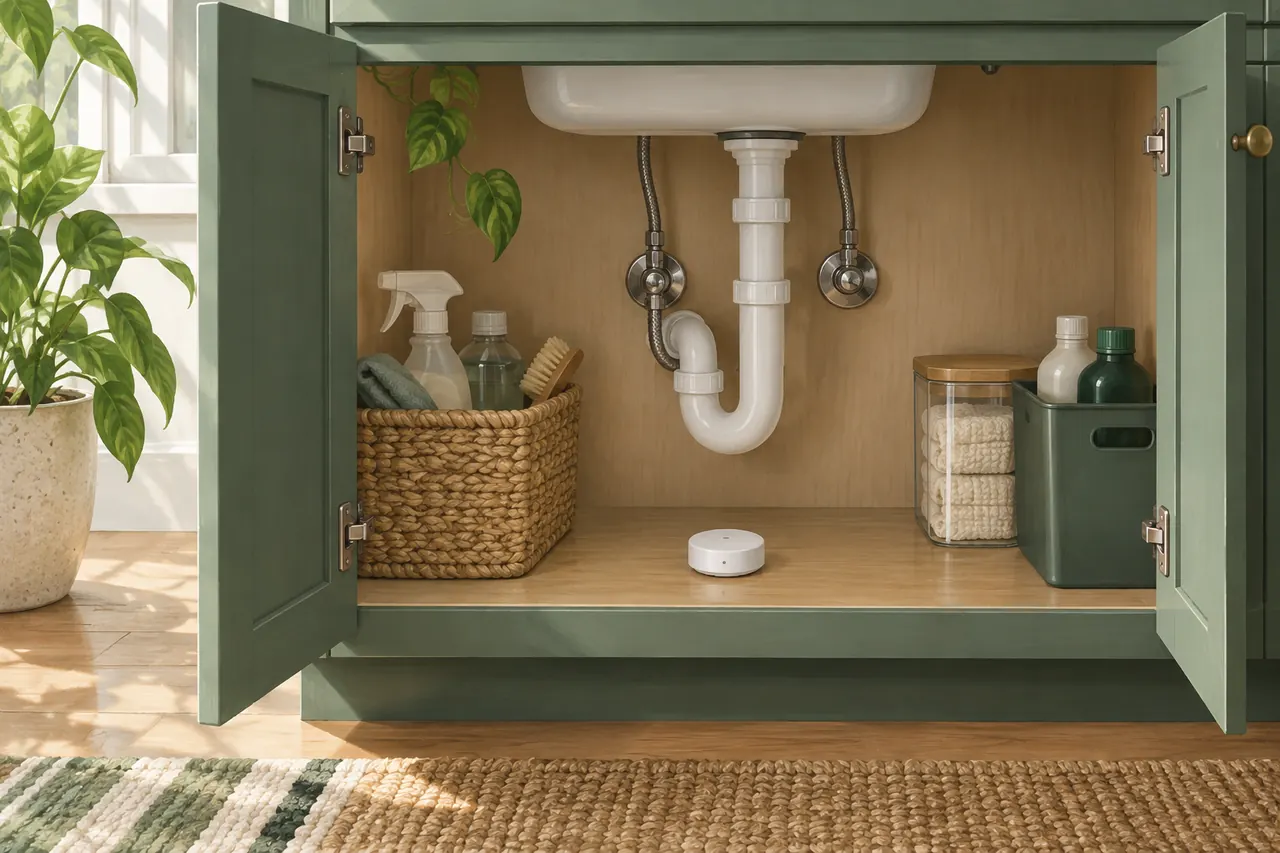
Write down the location and the problem you want to notice: a washing-machine area, a cabinet under a sink, or a water-heater area. Then ask how water would reach a detector in that location. Follow the manufacturer's placement and testing instructions.
For a rental, begin with a conversation with the property manager about the response plan and any permission needed for equipment. For a home you own, decide whether your concern is one location or the wider plumbing supply before requesting quotes.
Read the outage details carefully
“Works without internet” and “works without electricity” are separate claims. Ask about both.
Moen provides a useful example of why the distinction matters. Its Flo Shutoff support page says automatic closure may still occur while disconnected from the internet, while notifications, remote control and live data are unavailable. That statement does not establish operation during a power failure. Moen offline guidance (opens in a new tab)
Moen also specifies a 2.4 GHz home Wi-Fi network for proper operation of its Flo Detector. Treat this as a requirement for that product, not a rule for every detector. Moen detector connectivity (opens in a new tab)
Have the seller or installer fill in these answers for the exact system:
| Situation | Answer to request |
|---|---|
| Internet service fails, power remains | Does local detection continue? Does automatic closure continue? Which alerts stop? |
| Home loses power | What powers each detector, valve, hub and router? What is the supported backup arrangement? |
| Phone is unavailable | Who else receives the alert, and who can reach the property? |
| App or cloud service is unavailable | Which controls remain accessible at the device? |
| Valve closes unexpectedly | How is the cause checked, and who can safely restore service? |
Do not infer the behavior of a connected sensor-to-valve link from a statement about the valve's own flow monitoring. Ask about that link separately.
Ask for a complete installation scope
Moen calls for professional installation of its Flo Shutoff. More generally, the quote should identify the product and the work required for your particular plumbing. Moen Flo Shutoff overview (opens in a new tab)
Use these questions when talking with an installer:
- What exact model, pipe size and location are you proposing?
- Which branches will it control, and which will remain outside it?
- Does the home have fire sprinklers, a well, irrigation, treatment equipment or another system that changes the design?
- What power, network coverage and access space are required?
- What is included in the installed price: plumbing, electrical work, sensors, setup, any permits and demonstration?
- How will normal high water use be handled, and who will configure that behavior?
- What maintenance, battery changes or recurring charges should we expect?
- Will you demonstrate the manufacturer's test procedure and manual controls, and leave written instructions?
Have a qualified professional assess any plumbing changes and interactions with life-safety systems.
Decide who responds
Write one short household plan:
“If an alert arrives, ______ checks it. If that person is unavailable, ______ is the backup. The property manager or plumber's number is ______. Device instructions are stored at ______.”
Ask the installer how to respond to a closure before automatically reopening the valve. An alert should lead to finding the cause, not simply clearing the notification.
Your small task today
Choose one place where you want earlier notice of water, and name the person who would respond. Use that to decide what to investigate next. You do not need to choose a whole-home system today.
Use the home-resilience planner to keep the location, dependency questions and installer notes together.
How this article was prepared
Research checked September 11, 2026, using EPA guidance and Moen support documentation. Moen is an example of documented features, not a product winner. This is research-based guidance, not a hands-on test or a property assessment. Exact model and installation requirements need confirmation.
Sources checked September 11, 2026. General preparedness information, not individualized emergency or medical advice. Follow current local instructions. Our editorial approach.